
Consumer Unit & Fuse Board Upgrades
Your consumer unit — the fuse board — is the heart of your home’s electrics and its most important safety device. Modern boards detect faults in milliseconds and cut the power before a shock or fire can develop. Older boards simply can’t do that. If yours still has rewireable fuses, a wooden backboard, or no RCD protection, an upgrade is one of the most valuable safety improvements you can make.
Signs your fuse board needs replacing
 Old rewireable fuses — the kind you repair with fuse wire, instead of switches
- No RCD protection — no “test” button on the board
- A wooden backboard or cast-iron switches — common pre-1960s
- Frequent tripping — or fuses that blow repeatedly
- Buzzing, heat or scorch marks — around the board
- You’re planning an extension, rewire, EV charger or electric shower — new loads often need a new board
- An EICR has coded it C2 (or worse)
What a modern consumer unit gives you
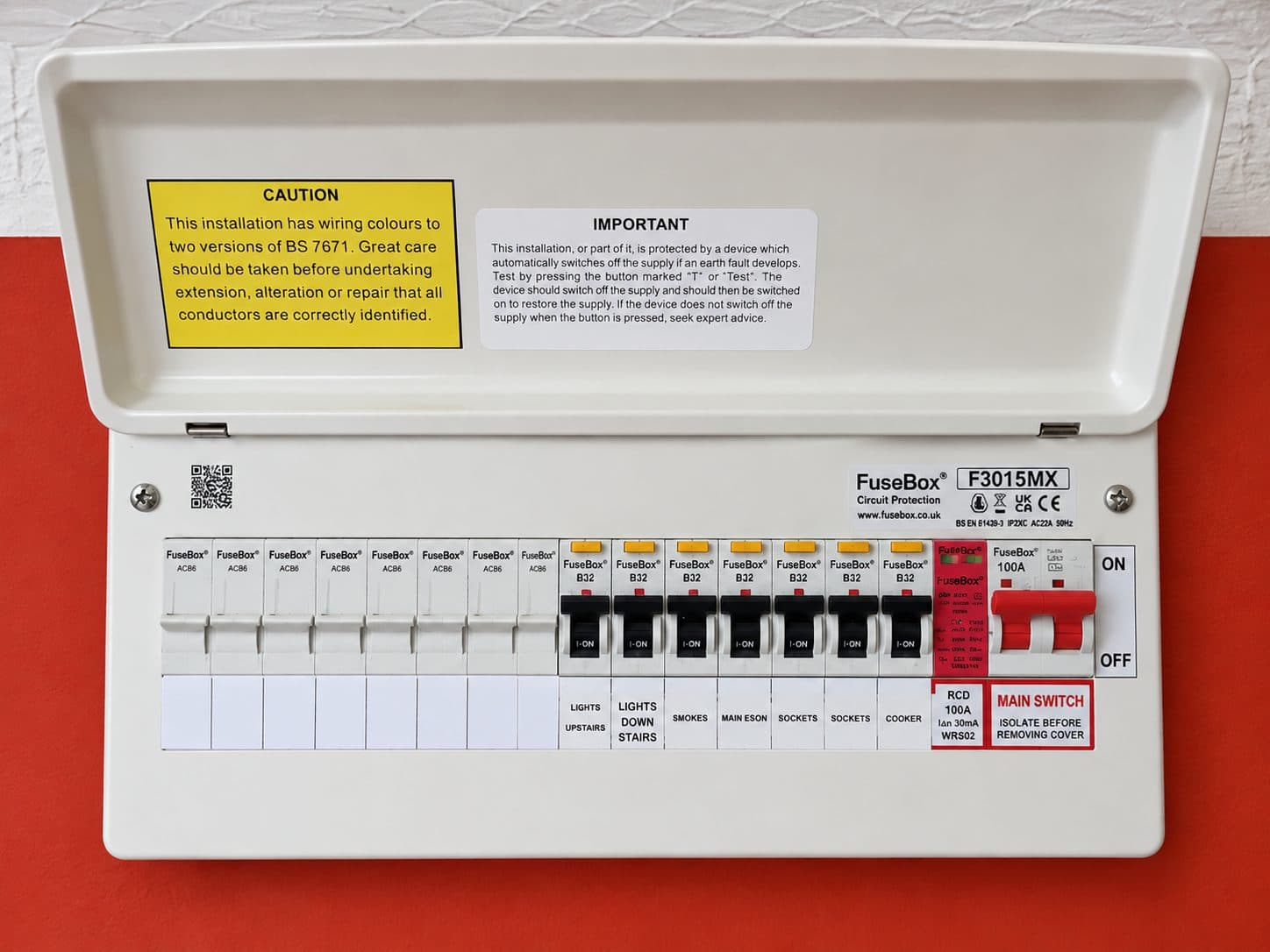
- RCD/RCBO protection on every circuit — cuts power in a fraction of a second if a fault or shock risk is detected. RCBOs protect each circuit individually, so one fault doesn’t black out the whole house.
- Surge protection (SPD) — protects electronics — TVs, computers, chargers, appliances — from voltage spikes; standard in our installs to current regulations.
- A metal, fire-rated enclosure — required by current regulations, containing any fault safely.
- Clear labelling — so you know exactly which switch controls what.
Everything, certified and notified
- Supply and fit of a modern metal consumer unit
- RCBO or dual-RCD configuration to suit the installation
- Pre-change testing of your circuits — we check what we’re connecting, and tell you if anything needs attention first
- Full testing and an Electrical Installation Certificate
- Building control notification under Part P — as NICEIC Domestic Installers we self-certify, so there’s no council paperwork or fee for you
How it works
- 01Assessment
We inspect your current board and circuits and give you a fixed quote.
- 02Install day
Usually completed in a day, with power off for part of it (we’ll agree timing so it disrupts you least).
- 03Testing
Every circuit tested to 18th Edition standards before we energise.
- 04Handover
Certificate, notification, labelling and a walkthrough of your new board.
The extras, explained
Modern boards can include more than RCDs, and it’s worth knowing what’s worth having. Surge protection (SPD) guards everything with a circuit board in it — TVs, laptops, appliances, EV chargers — against voltage spikes, and current regulations expect it in most new boards; we fit it as standard. Arc-fault detection (AFDD) goes further, spotting the electrical “sparking” signature of damaged cables and loose connections before they become fires — genuinely valuable in some homes (older properties, rentals, homes that sleep upstairs), unnecessary gold-plating in others. We’ll tell you which camp you’re in. While we’re there we also check your earthing and bonding — the unglamorous part of the job that makes everything else safe, and a common surprise in older homes.
What affects the price is mainly four things: how many circuits your home has (each needs its own protective device); whether we’re fitting RCBOs (per-circuit protection) or a simpler dual-RCD board; the state of your earthing and bonding, which sometimes needs bringing up to standard as part of the job; and any faults on existing circuits that the new board’s testing reveals. We inspect before we quote, so the price you get is fixed and covers the actual job — not a teaser that grows on the day.